





Tankless vs Tank Water Heater in Georgia: Which One Is Right for Your Home?

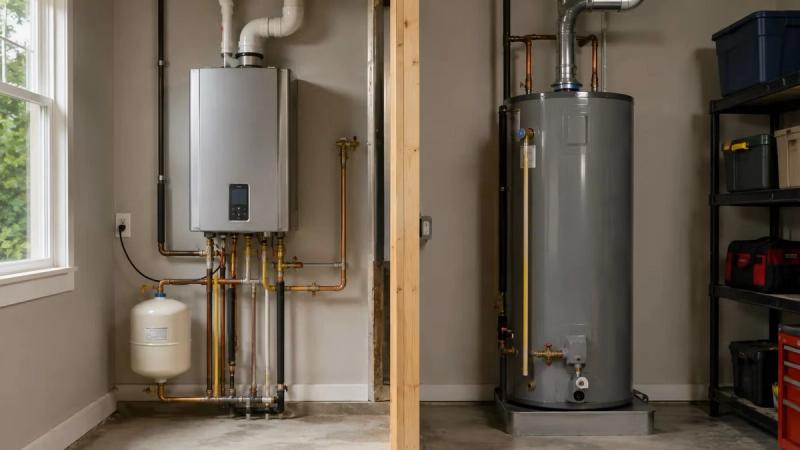
For many Georgia homeowners, the choice between a tankless and traditional tank water heater comes down to balancing upfront cost with long-term value. Georgia's warmer groundwater, hard water conditions in some areas, and occasional storm-related power outages can all influence which system is the better fit for your home.
The Core Difference: How They Work
Before looking at regional factors, the baseline mechanics define what you are paying for:
- Traditional tank water heaters store 40 to 50 gallons of water in an insulated reservoir, keeping it heated continuously so it is ready whenever you turn a handle.
- Tankless water heaters (often called on-demand units) eliminate the storage tank entirely, firing up a high-powered heat exchanger to warm water instantly as it flows through the pipes.
How Georgia’s Climate Changes the Equation
1. Warmer Groundwater Helps Tankless Units Perform
Tankless systems are rated by how many degrees they can raise incoming water temperature at a specific flow rate. The colder the incoming water, the harder the unit has to work.
In northern states, winter groundwater drops near freezing, forcing tankless units to strain to hit comfortable shower temperatures. In Georgia, groundwater runs significantly warmer year-round, ranging from roughly 62°F in winter up to 72°F in summer. Because the local groundwater requires less temperature rise, a tankless unit installed here performs much closer to its maximum rated output than it would up north.
2. North Georgia Hard Water and Mineral Scale
Much of north Georgia, including metro Atlanta and surrounding suburbs, has moderately to very hard water packed with calcium and magnesium. When that water is heated, minerals drop out of suspension and form scale.
With traditional tanks, sediment settles quietly at the bottom of the reservoir, eventually causing rumbling noises and eating away at the inner lining. Tankless systems react differently because scale coats the inner walls of the compact heat exchanger, choking off water flow and reducing efficiency.
Because a tankless heat exchanger has much narrower water passages than a traditional storage tank, even moderate scale buildup can reduce efficiency and restrict water flow. If you live in a hard-water area, plan on annual descaling to keep the system performing well. A whole-house water softener can also help reduce mineral buildup and extend the unit's lifespan.
3. Mild Winters Simplify Sizing
Because Georgia winters are mild, homeowners rarely need to oversize their tankless equipment to handle extreme cold-weather demand. A single properly sized unit can comfortably handle an entire household through January without the capacity drops seen in colder climates.
4. Storm Season and Power Reliability
Severe weather and occasional storms frequently knock out power across the region. This is where traditional design holds a distinct advantage. Electric tankless units shut down completely the moment the grid goes dark. Gas tankless units still rely on electricity to power internal ignition systems and blowers, meaning they also fail during a blackout unless paired with a generator.
Tank water heaters, especially gas models with a standing pilot or basic battery sparker, hold a reserve of 40 to 50 gallons of already-heated water, providing a reliable buffer when the power fails.
Head-to-Head: Cost, Efficiency, and Lifespan
| Factor | Traditional Tank | Tankless System |
|---|---|---|
Typical Upfront Cost (Installed) | $1,000 to $2,700 | $2,000 to $6,000+ |
Energy Efficiency | Uses standby energy to keep water hot 24/7 | 8% to 34% more efficient; runs only on demand |
Typical Georgia Lifespan | 8 to 12 years (shortened by hard water) | 15 to 20+ years (requires annual descaling) |
Hot Water Availability | Limited to tank capacity; 45-minute recovery | Endless supply, provided flow limits aren't exceeded |
Space Requirements | Bulky floor-standing cylinder | Compact, wall-mounted unit |
Power Outage Performance | Some gas tank models may continue operating without electricity, while others require power for electronic controls; stored hot water provides a temporary supply | Most units require electricity for controls, ignition, and fans, so operation usually stops during outages |
Note: Tankless upfront pricing climbs higher if an older home requires upgraded gas lines, heavier electrical panels, or custom exhaust venting.
Pros and Cons for Georgia Homes
Tankless Systems
- The Good: Tankless systems provide continuous hot water for larger households, save valuable utility space with a compact design, and reduce standby energy loss by heating water only when needed.
- The Drawbacks: They come with higher upfront installation costs, require more maintenance in hard-water areas, and typically rely on electricity to operate even when powered by gas.
Traditional Tanks
- The Good: Traditional tank water heaters offer lower upfront costs, simpler installation, and easier maintenance compared to tankless systems.
- The Drawbacks: They take up more space, have limited hot water capacity, and lose energy from continuously keeping stored water heated.
Making Your Decision
Choosing the right water heater isn't about finding a universal winner—it's about finding the best fit for your home. Your household's hot water demand, existing gas or electrical setup, local water quality, and how long you plan to stay in the home all play a role in which option delivers better long-term value.
When you are ready to weigh your options, getting a professional evaluation of your current utility setup, water hardness, and household demand is the best next step. Homeowners across Dacula, Lawrenceville, Suwanee, and the surrounding north Georgia area can explore our water heater installation and repair services to get a transparent assessment. For more details on the long-term savings side, our guide on the benefits of tankless water heaters breaks down how those systems handle efficiency over time.